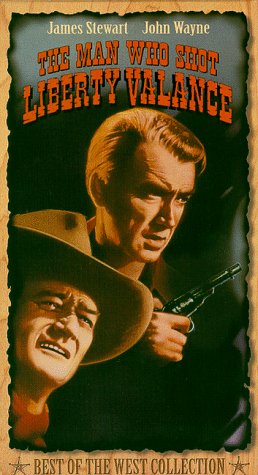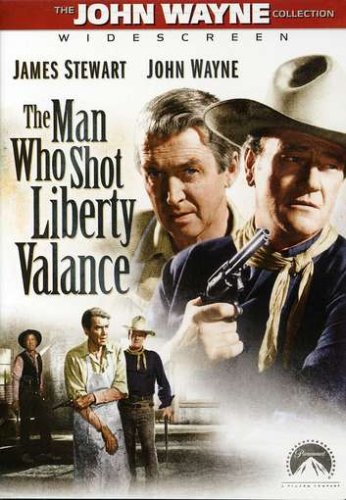
"When the legend becomes fact, print the legend." That's more than the code of a newspaperman in
The Man Who Shot Liberty Valance; it's practically the operating credo of director John Ford, the most honored of American filmmakers. In this late film from a long career, Ford looks at the civilizing of an Old West town, Shinbone, through the sad memories of settlers looking back. In the town's wide-open youth, two-fisted Westerner John Wayne and tenderfoot newcomer James Stewart clash over a woman (Vera Miles) but ultimately unite against the notorious outlaw Liberty Valance (Lee Marvin). Ford's nostalgia for the past is tempered by his stark approach, unusual for the visual poet of
Stagecoach and
The Searchers. The two heavyweights, Wayne and Stewart, are good together, with Wayne the embodiment of rugged individualism and Stewart the idealistic prophet of the civilization that will eventually tame the Wild West. This may be the saddest Western ever made, closer to an elegy than an action movie, and as cleanly beautiful as its central symbol, the cactus rose.
--Robert Horton Customer Review: Print The Legend
Stylistically, this is a very interesting film from director John Ford. The film begins with alot of colorful characterizations familiar to audiences with films as diverse as "Stagecoach" and "The Searchers". There's also alot of brutal realism which would anticipate the work of Sam Peckinpah. It's also interesting that Ford contrasts the traditional western as represented by John Wayne with the new west represented by James Stewart who made a series of "psychological" westerns in and around this time. Also noteworthy is the presence of Lee Van Cleef who made his mark in the terrific Sergio Leone westerns in the sixties. What is Ford trying to say here? Probably sensing that his days behind the camera were nearing an end he probably understood that a re-evaluation was in order. The paradox here is that the traditional hero represented by John Wayne is left to lick his wounds in the darkness while the more neurotic Stewart is the supposed victor. The law of the gun is being replaced by the law book. Ford sees this as a good thing but not without a touch of poignancy. This is a film that some viewers may be confused by but taken in the context of the Ford canon it makes perfect sense.
Customer Review: A parody
This is an unintentional parody of the Western movie. The cliches, stereotypes, corny lines, and macho nonsense are present in abundance. There are signs of trouble from the beginning, when we learn immediately that there will be a flashback: Jimmy Stewart is shouting his lines. Later, John Wayne swaggers and sniggers, Andy Devine whimpers and attempts to be amusing, Edmund O'Brien does an awful drunk act, things are rowdy in the local saloon...well, you understand if you're over 13. Watch how fast Stewart recovers from a savage beating after he sips some brandy. And don't miss the by now obligatory civil rights salute. The ending is wholly predictable. My educated guess is that John Ford, Lee Marvin, and many others on the set were tipping the bottle a bit too much. This is a dreadful, if often quite funny, film. It was Ford's worst, Stewart's worst, and ranks at least fourth from the bottom in Wayne's career.
A fitting metaphor for the young 21st century, and the ever-increasing intrusiveness of government at all levels, is this weeks news stories detailing the total lack of progress in rebuilding the World Trade Center. This is the cherry on top of the proverbial bitter bureaucratic sundae. Is this the America of yore? What has happened to us?
Utilizing the relatively primitive construction techniques of the Depression era, the Empire State Building was conceived and constructed in 410 days. Men were hungry and desperate at that time. Government, pre-New Deal, was much smaller at all levels. The State of New York and government of New York City were willing partners in seeing this important symbol of progress rise as a statement against the pessimism so rampant in the early-1930's. They both put the interest of the public ahead of entrenched bureaucratic concerns.
The Empire State Building is one of the world's great buildings, a tourist attraction since the day it opened and a symbol of the greatness of New York City and the United States. The construction of this landmark building was so steadfast that it absorbed a direct hit from an airliner during World War 2 with virtually no damage. It remained open for business.
The building is praised in song, on stage and has been the setting for many popular films. A visit to the building today still amazes. The building is fully functional, productive and ever elegant in its timeless art deco classic styling. Unless modern bureaucracy injects it's ugly rapacious tentacles, the Empire State Building will be used and enjoyed for many more generations.
Other massive projects of that era are equally as impressive. The Carew Tower in Cincinnati, the Hoover Dam, Boulder City, NV, the Golden Gate Bridge, hundreds of water control projects, sanitation systems, dams, airports and ports were built in blazing fashion. Essentially the infrastructure of the country was built in record time during the first 1/3 of the 20th century. By today's standards, using relatively inferior materials and technology, the performance of our great grandfathers and grandmothers was positively scintillating. What is going on today?
During the 1950's President Eisenhower proposed, conceived and began construction of the Interstate Highway System. Over 40,000 miles of bridges, highways, interchanges and tunnels were designed and built across this huge country. The system took about 30 years too fully complete. It was the largest road construction project in history, the largest since the Roman's connected the vast lands of their conquered empire with their amazing road system.
Nevertheless, today we need to continually widen, expand, and redesign the Interstate Highway system to efficiently handle ever-increasing volumes of traffic. And yet we see very little progress. "Orange Barrels" are a symbol of our bureaucratic malaise. We see lots of barrels along our roadways, but we see not much movement on any public works road project for mile, after mile, after mile, year after year, after year. Sunny weather does not seem to illicit any more production that nasty weather days.
I live in the Cincinnati area. The major transportation corridor is the I-75 Brent Spence Bridge crossing the Ohio River into Kentucky. The bridge is a relic. There are no shoulders, the lanes do not meet regulation width, there are always wrecks, breakdowns and it is structurally dangerous. Every politician, bureaucrat and citizen knows and agrees it must be replaced. It is the key link between Michigan and Florida for commercial truckers and travelers.
However, there is no consensus on if, where, when and how to finance the replacement-bridge and get it built. The permit process (hello bureaucracy) is ever changing, and that has been embellished by the Environmental Protection Agency (Federal and State) demanding ever-more studies of air quality. Neighborhood groups claiming historic status for old railroad terminals and faux local lore add another layer of hurdles to jump.
All of this, and much more, mean that there is no timetable to start the construction. Three more years of study will be needed. Another 10 years of construction are anticipated, if the studies do not reveal the need for more studies. And the cost, who knows! All we really know is that the bridge will cost bunches more in the future than it would today, or better five years ago.
The World Trade Center, as noted in the recent new updates, has seen anticipated construction costs expand to $15 billion. But because of the latest delays, the cost is probably now closer to $18 billion, but as always with bureaucracy no one really knows (remember Boston's "The Big Dig").
Almost seven years after the horrible destruction of the twin towers it is still mostly a hole in the ground.
What does this say about us? How have we so lost our way? We need nuclear power plants, oil refineries, alternative energy sources, infrastructure replacement and enhancement and new transportation systems. We all know we need to address these things. And yet, we can't because we largely hamstring ourselves with layer upon layer of bureaucracy, rules, regulations, licensing requirements, permit processes, etc. etc.
Our grandparents and parents have left us a bountiful lifestyle that was created by the toil and grit of their labors. The more we have the more we seem to take our plenty for granted. We don't want a power plant anywhere near us. But, we certainly want heat in the winter, cool in the hot summer and plenty of power to ramp up our myriad appliances whenever we wish to enjoy their benefits. No drilling for oil, offshore, onshore, or in a remote mosquito infested northern bog where no animal or man goes! But, we sure want oil for our cars and natural gas for our homes in quantity and preferably cheap! We can't have it both ways.
The Indonesians, the Chinese, Indians and eastern Europeans have not inherited our bounty. They are creating theirs as we diddle here. The are building dams, roads, power plants, harvesting minerals and building infrastructure at a record pace. Their growing middle classes realize that sacrifice, hard work and vision are needed to advance in a competitive world. They will, and are doing what it takes to succeed.
When will Americans return to the ways of thinking that made this country great? We were the world's builders. President Kennedy said we would put a man on the moon in the 1960's-AND WE DID! President Teddy Roosevelt said we would build the Panama Canal when the French could not-AND WE DID! President Reagan said we would end Communism-AND WE DID! Thomas Edison said he would light the world-AND HE DID! Henry Ford said every man should be able to afford and own a personal automobile-AND THEY DID!
With attitude adjustment, and realization that centrally planned government has no answers, just more self-indulgent meddling in our affairs, we can begin to right our listing ship. It is up to each of us to pull our weight. Read a little history and remember that our patrimony has gifted us with much. We have a duty to begin acting in the real spirit of America once again.
Geoff Ficke has been a serial entrepreneur for almost 50 years. As a small boy, earning his spending money doing odd jobs in the neighborhood, he learned the value of selling himself, offering service and value for money.
After putting himself through the University of Kentucky (B.A. Broadcast Journalism, 1969) and serving in the United States Marine Corp, Mr. Ficke commenced a career in the cosmetic industry. After rising to National Sales Manager for Vidal Sassoon Hair Care at age 28, he then launched a number of ventures, including Rubigo Cosmetics, Parfums Pierre Wulff Paris, Le Bain Couture and Fashion Fragrance.
Geoff Ficke and his consulting firm, Duquesa Marketing, Inc. (http://www.duquesamarketing.com) has assisted businesses large and small, domestic and international, entrepreneurs, inventors and students in new product development, capital formation, licensing, marketing, sales and business plans and successful implementation of his customized strategies. He is a Senior Fellow at the Page Center for Entrepreneurial Studies, Business School, Miami University, Oxford, Ohio.
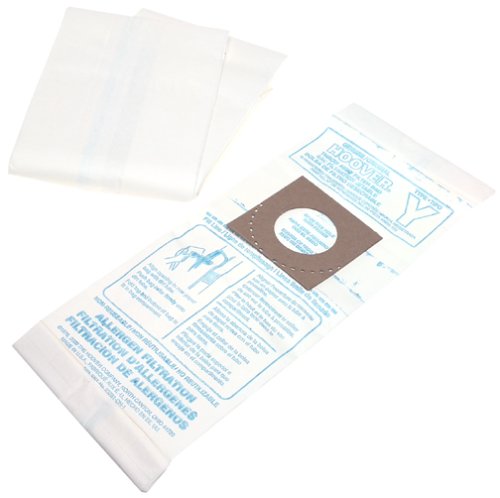
hoover 38528
 Makes fast work out of wet and dry messes, from spilled juice to coffee grounds. Simply store it in its wall mounted recharging rack and it's always at hand for those inconvenient messes. Grab it. Use it. Then move on to the better things in life. Carpet